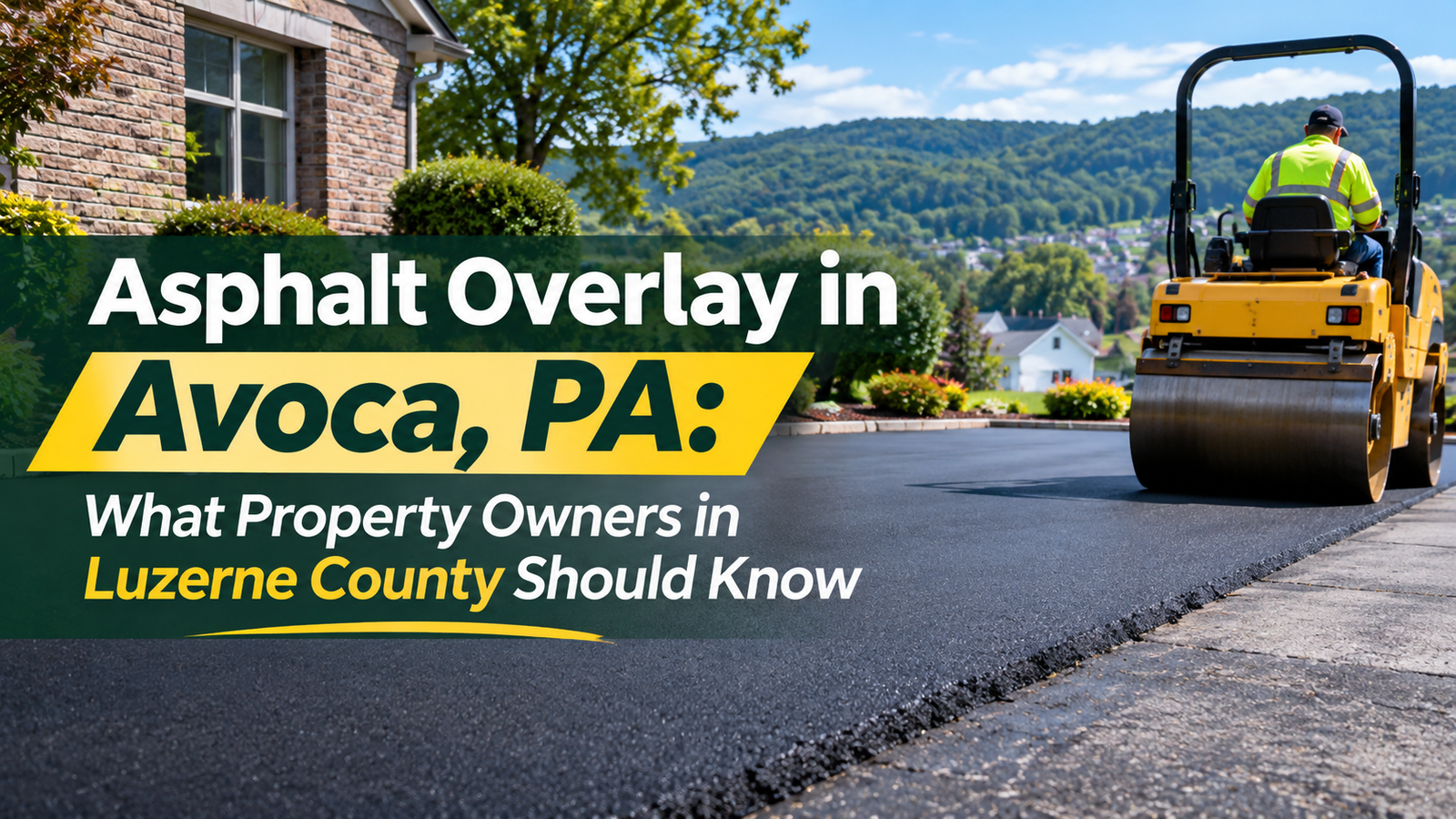
Avoca is a small borough in Luzerne County, Pennsylvania a tight-knit community in the Wyoming Valley with a mix of residential streets, commercial properties, and the kind of aging asphalt infrastructure that characterizes much of northeastern Pennsylvania. The region’s winters are demanding: regular freeze-thaw cycles work on pavement relentlessly, and driveways, parking lots, and private roads that have been in service for fifteen or twenty years often show the accumulated effects of Pennsylvania weather. Asphalt overlay Avoca placing a new layer of hot mix asphalt over an existing worn surface is one of the most practical and widely used approaches for restoring aged pavement in this region.
What Is an Asphalt Overlay?
An asphalt overlay is the process of placing a new course of hot mix asphalt directly on top of an existing asphalt surface without fully removing the old pavement. The existing surface serves as the base for the new layer, which bonds to it through a tack coat a thin layer of asphalt emulsion applied to the old surface before paving to promote adhesion between old and new asphalt. The result is a fresh driving surface that restores the pavement’s smoothness, weather resistance, and appearance without the full cost and disruption of complete removal and replacement.
Overlay is appropriate when the existing pavement has surface-level deterioration weathering, oxidation, minor cracking, raveling (loss of aggregate from the surface), and loss of surface texture but the base below remains structurally sound. When the base has failed, an overlay alone cannot fix the problem; the new surface will reflect distress from below quickly. The key diagnostic question before choosing overlay is whether the base is intact.
Common indicators that overlay is a viable option include: surface oxidation and weathering with the asphalt turning gray and brittle, minor longitudinal or transverse cracks that have not progressed to alligator cracking, some surface raveling, and overall surface roughness that affects ride quality but no significant rutting or deformation. When alligator cracking (the interconnected block pattern indicating base failure) is present over significant areas, spot repairs or full replacement are typically the right answer before an overlay is applied.
The Overlay Process in Pennsylvania’s Climate
Hot mix asphalt overlay in Pennsylvania follows the paving season constraints of the state’s climate from approximately April through November, with the shoulder months dependent on day-to-day weather conditions. PennDOT’s specifications, which govern asphalt work throughout the state, establish temperature and weather thresholds for paving operations. Asphalt must be placed when ambient temperatures are above approximately 40 to 50°F and the base is not frozen, and rain during placement must be avoided.
Before overlay, the existing surface is typically prepared in one of two ways. Milling using a rotary drum cutter to remove one to two inches of the existing surface is the preferred preparation for overlays that need to maintain the existing surface elevation (such as where the transition to a garage floor, curb, or adjacent surface would become too high with an added layer). Milling also removes the most oxidized and deteriorated surface material, creating a fresh substrate with improved texture for bonding. For overlays where grade change is not a constraint, the tack coat and direct overlay without milling is a common and effective approach.
The overlay itself is placed by an asphalt paving machine a self-propelled machine that accepts hot mix from a dump truck, distributes it to the specified width and thickness, and partially compacts it with a screed. Following rollers steel drum and pneumatic tire types complete the compaction to the specified density while the asphalt is still at the right temperature for compaction. In Pennsylvania’s cooler spring and fall conditions, the window for compaction is shorter than in summer, and experienced paving crews adjust their pace and equipment accordingly.
Overlay Thickness and Mix Selection for Avoca
Standard residential overlay thickness in Pennsylvania is 1.5 to 2 inches of compacted hot mix asphalt. Commercial parking lots and driveways with heavier vehicle traffic typically use 2 to 2.5 inches. The mix type the aggregate gradation and binder grade specified for the job is selected for the application and regional climate. PennDOT’s Superpave mix specifications, which govern asphalt materials throughout Pennsylvania, designate mix types by nominal maximum aggregate size and performance grade binder appropriate for the Luzerne County climate.
The performance grade binder for the northeastern Pennsylvania climate must resist both high summer temperatures (which cause rutting if the binder is too soft) and cold winter temperatures (which cause low-temperature cracking if the binder is too stiff). The Avoca area falls in a PennDOT climate zone that typically calls for a PG 64-22 or similar binder grade, selected to perform across the temperature range the pavement will experience through its service life.
Recycled asphalt pavement (RAP) is widely used in Pennsylvania overlay mixes. PennDOT specifications allow specified percentages of RAP in new mixes, and using RAP reduces the virgin material content of the mix while meeting performance requirements. The recycled asphalt retains much of its original binder and aggregate quality, making it a valuable and sustainable component of new pavement.
Edge Details and Drainage in Avoca Overlays
Edge treatment is one of the most important details in a well-executed overlay, and it is also one of the most commonly neglected. Where the new overlay terminates at a property edge, curb, or adjacent surface, the asphalt must be properly tapered and compacted to prevent the feathered edge from raveling or cracking under traffic. A sharp, well-compacted edge sometimes called a “wedged” edge holds up far better than a feathered taper that lacks compaction.
Drainage is the other critical consideration. An overlay that traps water by raising the surface elevation above an existing drain inlet, by creating a berm at the low edge of a driveway, or by altering the cross-slope such that water ponds will fail faster than one that drains freely. Good overlay practice includes verifying that all drain inlets and outlet points will remain functional at the new grade and adjusting inlet frames if necessary.
How Long Does an Overlay Last in Pennsylvania?
A well-executed overlay on a sound base in Pennsylvania’s climate typically lasts 10 to 15 years before resurfacing is needed again, depending on traffic loads, maintenance practices, and weather. Regular sealcoating every 3 to 5 years and prompt crack filling extend overlay life significantly by preventing water infiltration into the new surface. Without maintenance, the same freeze-thaw mechanisms that degraded the original surface will work on the overlay at a similar rate.
The underlying base condition is the most important factor in overlay longevity. An overlay placed on a weakened base will show reflective cracking cracks in the existing base telegraphing through the new overlay within a few years. Proper base repair before overlaying, even if it means cutting out and patching localized weak areas, is the investment that makes the overlay last.
Frequently Asked Questions: Asphalt Overlay in Avoca, PA
How do I know if my driveway needs an overlay or a full replacement?
The key indicator is whether the base is intact. Surface-level issues weathering, minor cracking, loss of surface texture that have not progressed to alligator cracking or significant rutting typically indicate a sound base that can support an overlay. Walk the driveway and check for alligator cracking (interconnected cracks forming blocks), soft spots that flex under foot pressure, or significant rutting or depressions. These indicate base failure that requires correction before or instead of overlay. If the surface distress is predominantly oxidation and minor cracking with a firm, stable base, overlay is likely appropriate.
What is a tack coat and why is it applied before overlay?
A tack coat is a thin application of diluted asphalt emulsion applied to the existing surface before an overlay is placed. It serves as a bonding agent between the old asphalt and the new layer, promoting adhesion and preventing the two layers from slipping relative to each other under traffic loads. Without a tack coat, the new overlay may delaminate from the existing surface over time, particularly on grades and in areas of turning traffic. A proper tack coat is applied at the correct dilution rate enough to promote bonding without creating a slip plane from excess material.
Should existing cracks be filled before an overlay in Pennsylvania?
Yes cracks should be filled before overlay to prevent them from reflecting through the new surface quickly. Routing and sealing cracks in the existing surface with hot rubberized crack sealant before overlay provides a flexible, water-resistant bridge at the crack location that slows reflective cracking in the new overlay. While crack filling does not eliminate reflective cracking entirely the existing crack is still a stress concentration that will eventually work through the new layer it significantly extends the time before reflective cracking appears and reduces water infiltration in the interim.
Why does milling matter before overlay in some situations?
Milling removing the top one to two inches of existing asphalt with a rotary drum cutter is important when the new overlay would otherwise raise the surface elevation in a way that creates problems: transitions to curbs, garage floors, or adjacent pavements that would become too abrupt; drain inlets that would be buried or reduced in capacity; or utility covers that would be below the new grade. Milling also removes the most oxidized and deteriorated surface material, creating a better bonding surface for the new overlay. Where grade change is not a constraint and the existing surface is not severely deteriorated, direct overlay over a tack coat is a common and appropriate approach.